
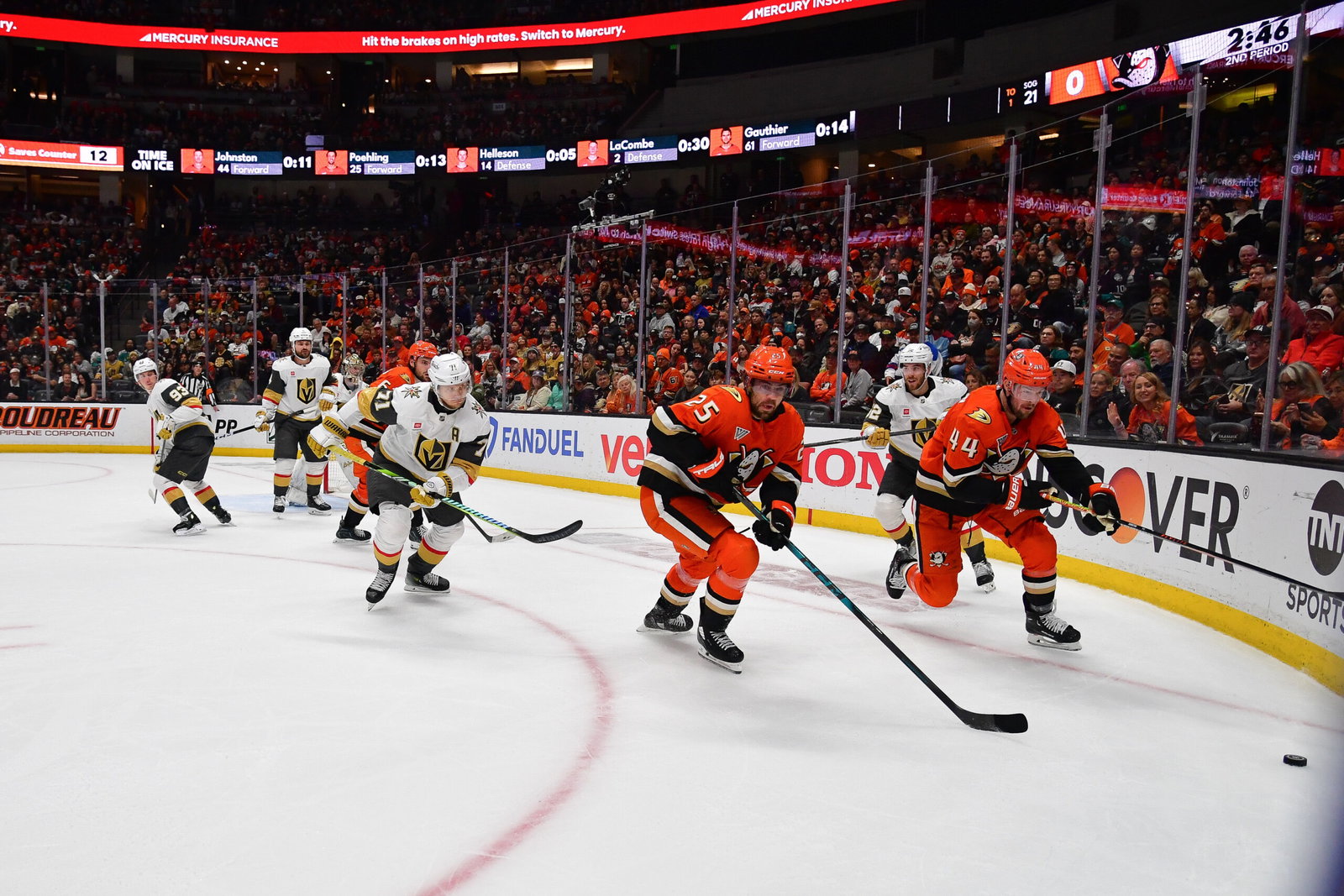
May 8, 2026; Anaheim, California, USA; Anaheim Ducks center Ryan Poehling (25) and left wing Ross Johnston (44) play for the puck against Vegas Golden Knights center William Karlsson (71) during the second period in game three of the second round of the 2026 Stanley Cup Playoffs at Honda Center. Mandatory Credit: Gary A. Vasquez-Imagn Images
May 8, 2026; Anaheim, California, USA; Anaheim Ducks center Ryan Poehling (25) and left wing Ross Johnston (44) play for the puck against Vegas Golden Knights center William Karlsson (71) during the second period in game three of the second round of the 2026 Stanley Cup Playoffs at Honda Center. Mandatory Credit: Gary A. Vasquez-Imagn Images
Overtime hockey creates a lot of excitement among fans. The sudden-death factor adds tension and suspense that few other sports can match.
The NHL is already one of the most exciting leagues in the world. From the speed to the skill to the physicality, hockey delivers must-watch action every night.
But overtime takes things to another level. Teams go up and down the ice with scoring chances on each end, and one mistake can end the game.
Since the NHL adopted the 3-on-3 format for regular season overtime, the highlights have been endless. We have seen crazy game-winning goals and incredible defensive stops that keep games alive.
And of course, playoff overtime hockey is in a league of its own. But the rules in the postseason are not the same as in the regular season.
For anyone unsure how it all works, here is a simple breakdown of NHL overtime rules.
NHL Overtime Rules for Preseason and Regular Season
In the regular season, things move quickly once regulation ends. Teams play a five-minute overtime period of 3-on-3 hockey.
The OT period is sudden-death, so the first team to score wins. There is no chance for the other team to respond.
If no one scores in the five minutes, the game heads to a shootout. Each team selects three shooters for three rounds, with each team shooting once per round.
The team that scores the most goals after three rounds is declared the winner. If the teams remain tied, a shootout will occur, proceeding round by round until one team scores while the other does not.
NHL Overtime Rules for Playoff Games
In playoffs, if the game is tied after regulation, the teams play a full 20-minute overtime period at 5-on-5.
Just like the regular season, it is sudden-death. The first team to score wins the game.
But here is the catch. If no one scores in the first OT period, the game keeps going into a second, third, or even fourth overtime until someone finally scores.
There are no shootouts in the playoffs. Just pure, full-strength hockey until a winner is decided.
How NHL Overtime Has Changed Over the Years
The NHL has gone through plenty of overtime changes since the early days. Back in 1921, the league used a 5-on-5, 20-minute overtime period before cutting it down to 10 minutes in 1927.
In 1928, the league switched to a non-sudden-death format. The period ran for the full 10 minutes, no matter what, and games could still end in a draw.
Then came World War II. In 1942, overtime was scrapped from the regular season due to wartime train schedule issues.
Any tied game during the regular season simply ended in a tie. However, the playoffs kept the 20-minute sudden-death OT periods.
It took more than 40 years for regular-season overtime to come back. The NHL brought it back as a five-minute sudden-death period, played at 5-on-5.
That format remained in place until 1999, when the league transitioned to 4-on-4 play. During that same season, teams began to receive one point for a loss in overtime and two points for a victory.
The shootout arrived in 2005 after the NHL lockout. It officially ended ties in hockey for good.
Finally, in 2015, the league moved to the 3-on-3 format we know today. And so far, there are no plans to change it anytime soon.
Written by

Sahil Prashar
Edited by
Sahil Prashar